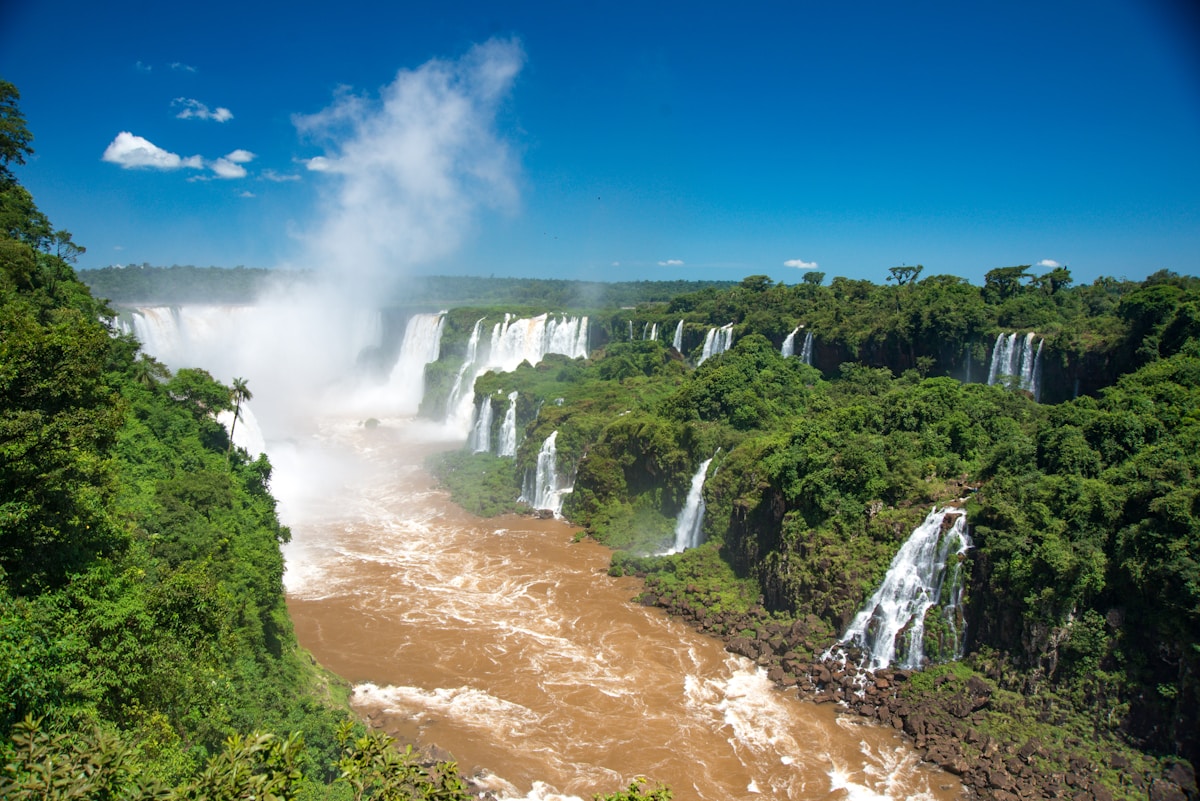
Iguazú Falls sits on the border of Argentina’s Misiones Province and Brazil’s Paraná State. The falls system is 2.7 km wide and contains 275 individual cataracts in wet season, dropping an average of 64–82 metres. The volume of water during high-water periods is among the highest of any waterfall on earth. Eleanor Roosevelt, on her first visit, reportedly said “Poor Niagara.”
The nearest Argentine town is Puerto Iguazú, 25 km from the national park entrance. This is where most visitors stay.
Argentine Side - Iguazú National Park
The Argentine side of the falls has three main circuits accessible on foot, plus boat excursions.
Circuito Superior (Upper Circuit): A flat walkway running along the top of several falls, giving elevated views looking down into the gorge below. Around 1.5 km, takes approximately 45 minutes. The views are wide rather than intense.
Circuito Inferior (Lower Circuit): A longer circuit (approximately 1.7 km) that descends to the base of several falls and to the shore of the Iguazú River. The proximity to the water is the main draw - spray is heavy on certain sections, particularly near Salto Bossetti and Salto Dos Hermanas. Allow 60–90 minutes.
Garganta del Diablo (Devil’s Throat): The centrepiece of the Argentine side and the most powerful single point in the system. A walkway of approximately 1 km extends over the river to a U-shaped platform suspended above the main cascade. The volume of water falling into the gorge from three directions produces a permanent cloud of spray and a roar that overrides conversation. The platform is frequently soaked in mist. This is the single most dramatic viewpoint of the entire Iguazú system. Allow 30–45 minutes for the walkway out and back.
The Garganta del Diablo is reached by a miniature train that runs within the park from the main visitor centre. The train is the only access point for the walkway; get on early to avoid queues.
Entry fees (Argentine side): Fees are subject to frequent revision. As of 2026, international visitors pay approximately USD 30–40, charged in ARS at the official exchange rate. Verify current fees at iguazuargentina.com before your visit.
Opening hours: Generally 8am to 6pm daily, with reduced hours in the dry season.
Boat rides (Gran Aventura): The in-park boat tour, operated by Iguazú Jungle, departs from a dock accessible from the Circuito Inferior and drives directly into the curtain of water below one of the main falls. You will get entirely soaked - bring a dry bag for cameras and phones, or leave them at the dock. Cost is approximately USD 25–35 per person as of 2026, paid inside the park. This is separate from the park entry fee.
Brazilian Side - Day Trip from Puerto Iguazú
The Brazilian side sits in Iguaçu National Park (Foz do Iguaçu, Paraná State) and offers a panoramic walkway that runs along the canyon rim opposite the main falls. The view is horizontal rather than immersive - you see the entire Argentine side of the falls laid out in front of you at a distance. The perspective is genuinely different from the Argentine circuits and complements rather than duplicates the experience.
The main walkway (approximately 1.2 km) is flat and paved, ending at the Garganta do Diabo viewing platform - a different angle on the same gorge seen from the Argentine side. Brazilian park entry costs approximately BRL 70–100 per person (approximately USD 14–20 as of 2026).
Getting there from Puerto Iguazú: Most visitors join a day tour from Puerto Iguazú, which handles the border crossing and includes transport and park entry. Tours cost approximately USD 40–60 per person. Alternatively, public buses run to the Brazilian border, though the crossing and onward transport requires several steps; a tour is more practical for a short visit. Compare Iguazu day trips to find packages that combine the Argentine and Brazilian sides in two days.
Hito Tres Fronteras
The Three Borders Point (Hito Tres Fronteras) is 3 km from Puerto Iguazú town, where Argentina, Brazil, and Paraguay meet at the confluence of the Iguazú and Paraná Rivers. Each country has a viewpoint on its respective shore. The Argentine side has a free viewing area above the river junction with coloured obelisks marking the border - a popular photo stop. The equivalent sites on the Brazilian and Paraguayan shores are visible across the water. There are similar monuments on both the Brazilian side (Marco das Três Fronteiras, Foz do Iguaçu) and Paraguayan side (Salto del Guairá area).
Jungle Walks and Wildlife
The national park contains Atlantic Forest habitat that extends well beyond the falls circuits. Coatimundis (long-nosed raccoon relatives) are abundant and will approach visitors - do not feed them. Toco toucans are visible in the forest around the visitor centre. Caiman can be seen along the river banks from the lower walkways. The park also runs guided nature walks separate from the falls circuits for those interested in the forest rather than the water.
Practical Notes
- The Argentine side requires at least a full day; plan to be at the park gate when it opens to reach the Garganta del Diablo before midday crowds
- The miniature train to Garganta del Diablo fills quickly after arrival; go directly to the train station first, then do the lower circuits on the return
- Bring water, sunscreen, and a waterproof layer for the boat tour
- The wettest months are October–March (higher water volumes in the falls); May–August tends to be drier with clearer skies but lower flow
- Puerto Iguazú airport (IGR) has direct flights from Buenos Aires (AEP) taking approximately 1 hour 45 minutes
See also: Iguazu Falls travel guide · Where to stay near Iguazu Falls · Iguazu Falls visitor guide · Posadas and the Jesuit ruins · Iguazú vs Buenos Aires