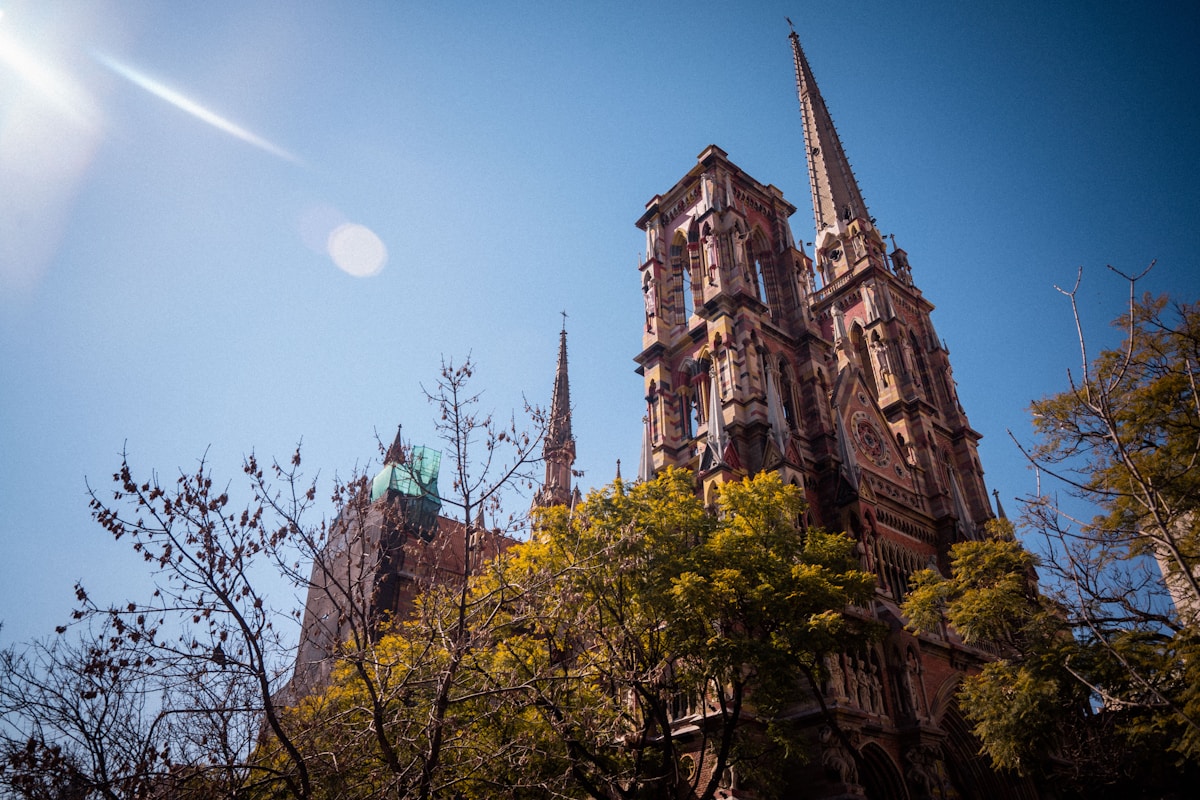
La Plata, Argentina: Cathedral, Museum & Visiting
Latin America's largest neo-Gothic cathedral, a world-class natural history museum, and 60 km from Buenos Aires - La Plata makes an easy day trip.
Guides for La Plata
La Plata was founded in 1882 as the purpose-built capital of Buenos Aires Province, after the city of Buenos Aires became federalised and separated from provincial jurisdiction. It was designed by Pedro Benoit on a rational grid of square blocks cut through by diagonal avenues, with public buildings - a cathedral, a museum, a theatre, government offices - distributed at regular intervals according to the original plan. The city today has around 800,000 residents and functions primarily as an administrative and university centre; it hosts one of the largest universities in Argentina. It sits 60 km south of Buenos Aires and is most commonly visited as a day trip.
La Plata Cathedral
The Cathedral of the Immaculate Conception dominates the Avenida 51 side of the central plaza and is one of the largest Neo-Gothic churches in the Americas. Construction began in 1884 and the final towers were completed only in 1999 - a building timeline that became a defining feature of La Plata’s civic identity. The interior has 12 stained glass windows rising 20 metres, a crypt beneath the high altar, and an on-site museum documenting the cathedral’s construction history. Entry to the cathedral itself is free; climbing one of the towers costs approximately ARS 1,500 per person (as of 2026) and gives views over the city’s geometric street grid. The towers are open Tuesday to Sunday from 10am to 6pm.
Museo de Ciencias Naturales
The Natural Sciences Museum sits in a symmetrical purpose-built structure in the Paseo del Bosque park, opened in 1888. Its palaeontology collection is genuinely exceptional - La Plata holds some of the most important dinosaur fossil specimens in South America, including the original cast of one of the largest titanosaur specimens ever excavated. The zoology and anthropology galleries cover Argentine fauna and pre-Columbian cultures. Entry costs approximately ARS 2,500 for foreign adults (as of 2026). The museum is open Tuesday to Sunday from 10am to 6pm and is worth two to three hours; arrive early on school days when group visits are scheduled.
Paseo del Bosque
The Bosque is a 60-hectare park running along the northeastern edge of the city centre, containing the Natural Sciences Museum, a zoo, an astronomical observatory, an open-air theatre, and a rowing lake. It functions as the city’s main public green space and is heavily used by university students. The zoo (Jardín Zoológico de La Plata) has been progressively converted toward open-range enclosures and charges approximately ARS 2,000 entry; it is a reasonable afternoon option, particularly with children.
Where to Stay
La Plata is most often visited as a day trip from Buenos Aires - tours from Buenos Aires frequently include La Plata - and the accommodation offering reflects that. For visitors who need or want to stay overnight, Hotel Land Plaza on Calle 44 is a comfortable mid-range option at approximately USD 50–70 per night with a central location two blocks from the cathedral. Hotel Corregidor on Calle 6 offers simpler accommodation from approximately USD 30–45 per night. Hotel Benevento near the civic centre is another mid-range option popular with business travellers, from approximately USD 45–65 per night. The university district around Diagonal 77 has several apart-hotels suited to longer stays.
Search hotels in La Plata on Booking.com
See our full hotels in La Plata guide for named picks near the cathedral and university district.
Where to Eat
Cervecería Modelo, on the corner of Calle 54 and Calle 5, is a La Plata institution operating since 1894 - a classic bar-restaurant serving steak, milanesas, and cold beer in a tiled dining room. Mains run approximately ARS 5,000–10,000 (as of 2026). Wilkenny on Calle 50 is popular with university students for craft beer and casual meals; portions are large and prices are moderate, around ARS 4,000–8,000 per main. La Modelo confitería near the cathedral serves coffee, facturas, and sandwiches for a quick mid-morning break. For fresh pasta, the cluster of Italian-descended restaurants along Diagonal 74 offers good-value set lunches on weekdays.
Getting There and Around
The Roca commuter line from Constitución station in Buenos Aires reaches La Plata in 50–60 minutes; trains run throughout the day using a SUBE card (approximately ARS 200 as of 2026 - one of the best-value journeys in Argentina). Long-distance buses connect La Plata to destinations across Argentina from the city’s main terminal on Calle 42. Buses from Buenos Aires on the Route 2 corridor also serve La Plata frequently and cost approximately ARS 800–1,200. Within La Plata, the city centre is compact and walkable between the cathedral, Bosque, and main plaza - about 15 minutes on foot. Remis taxis are available for longer distances.
Practical Tips
The city’s geometric layout makes navigation straightforward - streets are numbered rather than named. An odd-numbered street running parallel to a diagonal boulevard is a landmark in itself. The cathedral towers can be busy on weekends; weekday mornings are quieter. The Natural Sciences Museum crowds peak on school holidays. The Bosque park is safe during the day but avoid it after dark. La Plata also has two First Division football clubs - Estudiantes de La Plata and Gimnasia y Esgrima La Plata - and match-day visits bring the city to life if you coincide with a fixture at either Estadio Ciudad de La Plata or Estadio Uno.
Best Time to Visit
La Plata is a year-round destination with no strong seasonal constraint - it has the same temperate climate as Buenos Aires, with warm summers and mild winters. Visiting on a weekday gives quieter access to the museum and cathedral; weekends are livelier in the Bosque park area.
Explore more: Buenos Aires travel guide · Day trips from Buenos Aires · Things to do in Buenos Aires
Nearby: Tigre delta day trip · Getting around Argentina
Upcoming Events in La Plata
Iguazu National Park Anniversary
Iguazu National Park Anniversary 2026, 9 November. Free park entry, cultural events, and environmental programming in Puerto Iguazú.
Cosquín National Folk Festival
Cosquín Folk Festival 2027 runs 22 to 31 January in Córdoba province - ten nights of chacarera, zamba and folk on the Plaza Próspero Molina open-air stage.
Book an experience
Top experiences in La Plata
Explore the best tours and activities in La Plata , with instant confirmation and free cancellation on most bookings.
Planning to visit? Browse hotels in La Plata, free cancellation on most bookings.