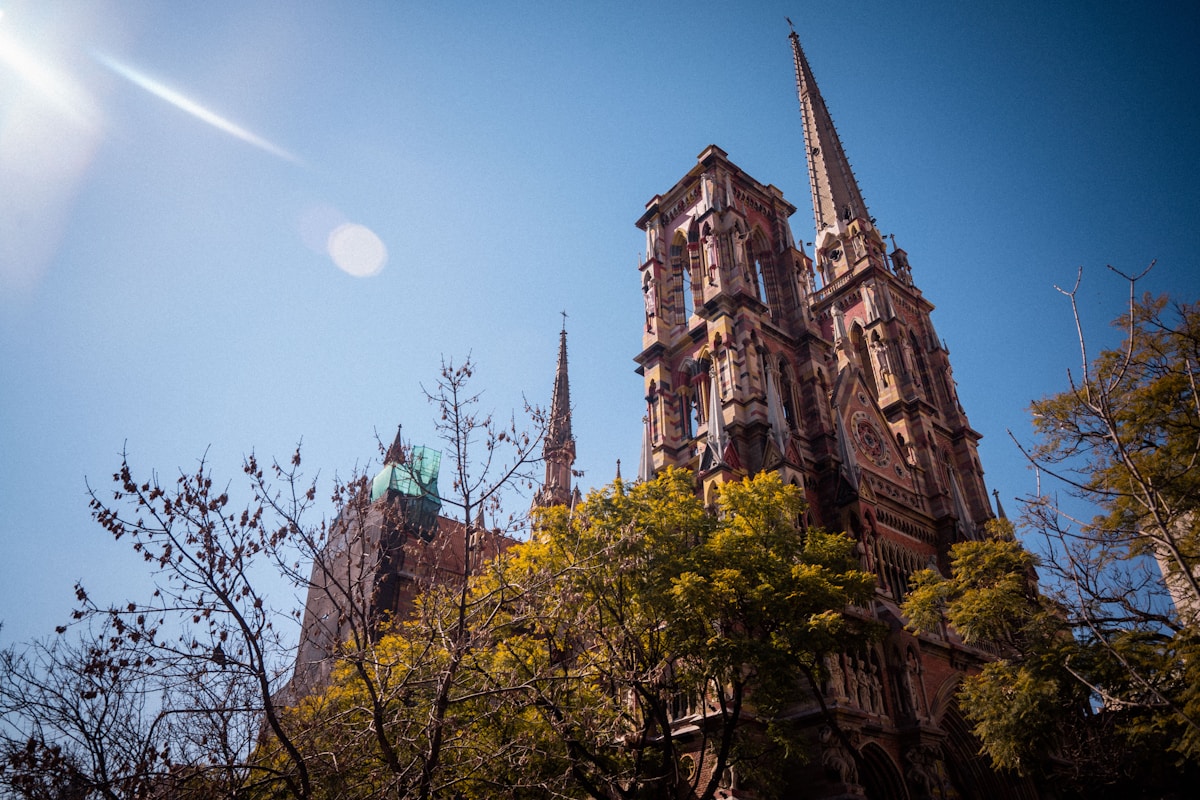
La Plata is one of Argentina’s most coherently planned cities — laid out in 1882 on a grid-and-diagonal system with cultural buildings distributed at regular intervals — and its main sights reflect that deliberate ambition. The cathedral took 113 years to finish. The natural sciences museum holds some of the best dinosaur fossils in South America. The Paseo del Bosque is a 60-hectare park that feels like a miniature Buenos Aires botanical space. Here is what to do in La Plata.
La Plata Cathedral
The Cathedral of the Immaculate Conception is the defining monument of La Plata, and one of the largest Neo-Gothic churches in the Americas. Construction began in 1884; the twin towers were completed only in 1999 — a timeline that defines the city’s civic self-image as a place of ambitious, patient projects. The façade is modelled after the cathedrals of Cologne and Amiens, with flying buttresses, elaborate stonework, and 12 stained glass windows rising 20 metres inside.
Inside the cathedral: The central nave is 120 metres long and visually overwhelming in scale. The stained glass is consistently beautiful; arrive in the morning when the eastern light comes through at its best. The underground crypt beneath the high altar holds the remains of notable Bonaerense figures and is worth the few minutes to see.
The tower climb: Climbing one of the towers (ARS 1,500 per person, as of 2026) is the best way to understand La Plata’s street geometry — the diagonals crossing the rectangular grid are visible from above in a way that makes no sense at street level. The climb involves 130 steps; the view at the top extends to the Río de la Plata estuary on a clear day.
On-site museum: A small museum documenting the cathedral’s construction history occupies a ground-floor annex — models, photographs, and engineering drawings covering the 1884–1999 building timeline. Entry is modest; 20–30 minutes is enough. Tower and museum: Tuesday to Sunday, 10am–6pm. Main cathedral: open daily.
Museo de Ciencias Naturales (Natural Sciences Museum)
The Natural Sciences Museum is the most substantive cultural destination in La Plata, and by some measures the best natural history museum in South America. It sits in a symmetrical Greco-Italian building in the Paseo del Bosque, opened in 1888, and its palaeontology collection alone justifies the trip from Buenos Aires.
Palaeontology hall: The fossil collection includes original specimens and casts of titanosaur sauropods — some of the largest animals that ever lived on land — as well as well-preserved Triassic and Cretaceous specimens from Patagonian excavations. A mounted titanosaur skeleton occupies the central hall at a scale that stops visitors mid-step. The collection is better contextualised than most Argentine museum palaeontology displays.
Zoology and ecology: Mounted specimens of Argentine fauna — pumas, condors, giant anteaters, tapirs — cover the upstairs galleries. The display standards are somewhat dated but the breadth is impressive. Budget 2–3 hours for the full museum; the palaeontology floor alone takes 1.5 hours if you read the panels.
Entry and hours: Approximately ARS 2,500 for foreign adults (as of 2026). Open Tuesday to Sunday, 10am–6pm. Arrive before 11am on school days — class groups fill the palaeontology hall mid-morning.
Paseo del Bosque
The 60-hectare Bosque park runs along the northeastern edge of the city centre and functions as the city’s green lung. Within its boundaries: the Natural Sciences Museum, the Jardín Zoológico (zoo), an astronomical observatory open for public nights, an open-air theatre, and a rowing lake used by the university athletics club. University students use it as an outdoor study space on weekdays; families take over at weekends.
Jardín Zoológico: The La Plata zoo has been progressively updated toward open-range enclosures. Entry approximately ARS 2,000 (as of 2026); the big cats, capybaras, and river otters are the highlights. Reasonable for an afternoon with children; the grounds are pleasantly landscaped with mature trees.
Observatorio Astronómico: The yellow-domed observatory was inaugurated in 1884 and is one of the oldest in South America. It runs public observation nights on clear Fridays and Saturdays; entry approximately ARS 1,500 (as of 2026), booking ahead is advisable in the school holiday season. The main refractor telescope is still operational and the 19th-century instrument collection is impressive.
Teatros del Bosque: The open-air theatre amphitheatre hosts free concerts and performances through spring and summer (October–March). Check the municipal cultural calendar for scheduling; arriving on an evening with a concert coincidence is a genuine La Plata bonus.
Pasaje Dardo Rocha
The Pasaje Dardo Rocha is a covered cultural centre occupying a former railway station building (1883) on Calle 50 between Calles 6 and 7 — a handsome cast-iron and glass interior converted into a civic arts space. It houses rotating photography and contemporary art exhibitions, a cinema screening independent films, craft markets on weekends, and a café. Entry to the exhibitions is free or involves a minimal charge.
The building itself is worth the visit — the iron colonnade and vaulted glass roof are among the best surviving 19th-century civic structures in Buenos Aires Province. Worth 30–45 minutes on any La Plata visit; the weekend craft market inside is good for local artisan work and food products.
Football: Estudiantes and Gimnasia
La Plata has two First Division football clubs occupying the same city — a genuine rivalry that defines much of the city’s social calendar. Estudiantes de La Plata (known as El Pincharrata) plays at Estadio Uno, a purpose-built 30,000-seat stadium in the city’s east. Gimnasia y Esgrima La Plata (known as El Lobo, the wolf) plays at Estadio Juan Carmelo Zerillo. Both clubs compete in the Argentine Primera División and draw significant crowds.
Attending a match — even a midtable league game — gives a completely different view of La Plata from the tourist-museum circuit. Tickets for league matches start from approximately ARS 5,000–15,000 (as of 2026); buy through the club websites or the Ticketek platform. Check fixture schedules before travel if you want to coincide with a home match.
The City Grid Itself
La Plata is worth walking simply as an exercise in planned urban design. The 1882 master plan (by Pedro Benoit with input from European engineers) imposed a rational grid over a diagonal overlay, creating intersections where diagonals and right-angle streets meet at irregular angles. Every twelve blocks there is a park or public building. The result on the ground is a city that consistently surprises — turning a corner to find a cathedral, a museum, or a named plaza where another Argentine city would have another corner shop.
Walk the 15-minute route from Plaza Moreno to the Bosque via Diagonal 80: you pass the cathedral, the Pasaje Dardo Rocha, the Natural Sciences Museum, and the zoo entrance, covering most of La Plata’s main sights in one uninterrupted walk.
See also: Where to stay in La Plata · Food in La Plata · La Plata travel hub
Nearby: Buenos Aires travel guide · Day trips from Buenos Aires · Tigre delta day trip