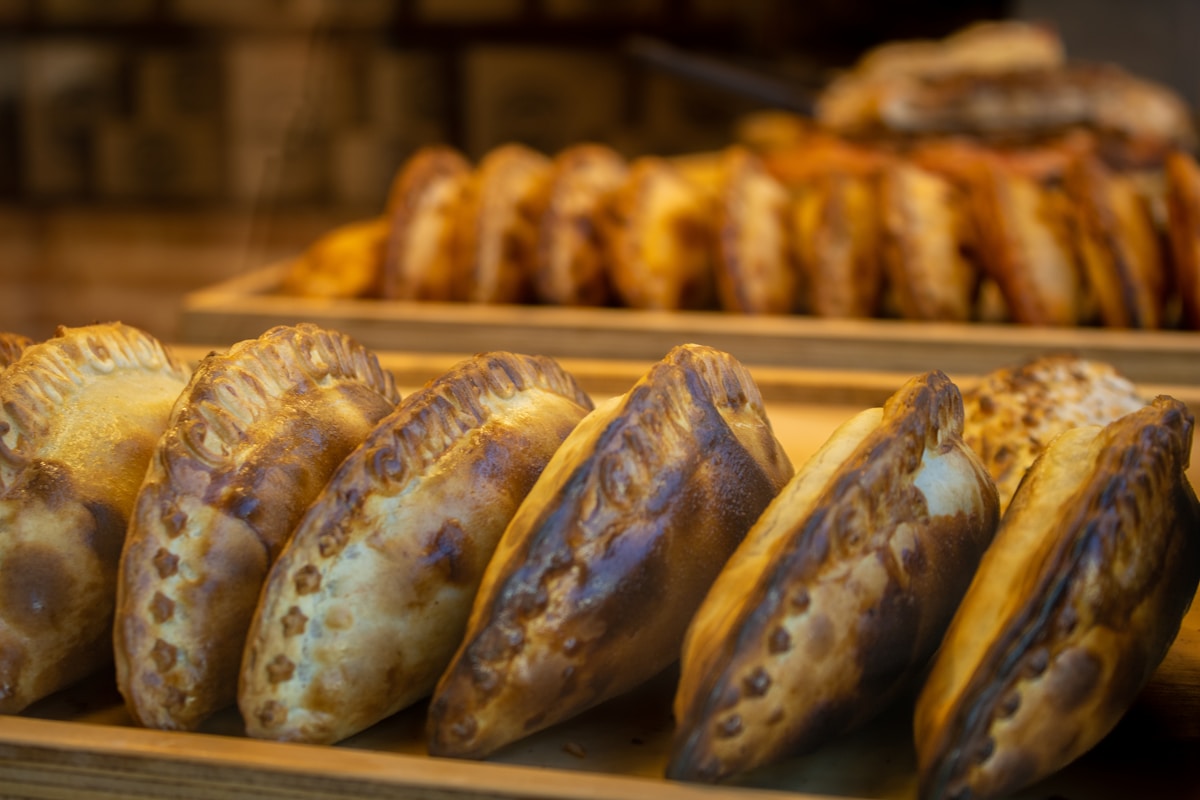
Empanadas are the most widely eaten food in Argentina. They appear at every meal format - starter, main course, snack, street food - and every region has its own established version. Understanding the regional differences adds considerably to eating them across the country.
What Defines an Empanada
An empanada is a filled and sealed pastry parcel, either baked (al horno) or fried (frita). The pastry (masa) is made from flour, fat (lard in traditional recipes, butter or oil more commonly now), water, and salt. The filling (relleno) is cooked separately and cooled before filling, so the pastry cooks at the same time as the filling warms through.
The crimp (repulgue) is the sealed edge of the pastry, formed by folding and pressing. The style of repulgue traditionally indicates the filling - a useful system in households or restaurants that make multiple varieties. The pattern varies by region: a twisted rope-style crimp in Tucumán, a simple folded edge in Buenos Aires.
Regional Varieties
Tucumán
Tucumán empanadas are considered the benchmark by most Argentines. The province holds a national empanada championship each September, and empanada shops - locally called empanadas tucumanas - operate throughout Buenos Aires and other cities selling specifically the Tucumán style.
The filling uses hand-diced beef (not minced) - typically recortes (off-cuts) or bola de lomo - cooked with white onion, spring onion, paprika, cumin, and chilli. Hard-boiled egg and green olive are added off the heat. The spice balance is assertive: cumin is the dominant note, giving Tucumán empanadas their characteristic aroma. The pastry is thinner than Buenos Aires versions and baked in a very hot oven, producing a slightly charred, crisp exterior.
A Tucumán empanada is eaten in two or three bites and held in the hand. The cooking juice inside - called jugo - is a marker of quality; a dry filling indicates overcooked or low-fat meat.
Salta
Salta’s empanadas are closely related to the Tucumán style but with two key differences: potato is added to the filling (diced small and cooked with the meat), and the overall spice profile tends to be slightly less intense. The potato adds texture and absorbs the cooking juices, making Salta empanadas slightly less juicy than Tucumán versions but with a fuller, rounder flavour.
The pastry in Salta is also sometimes made with fat added to the dough in a higher ratio, producing a richer, more golden exterior. Fried empanadas are more common here than in Tucumán.
Mendoza
Mendoza empanadas are distinguished by a much higher proportion of onion in the filling - up to equal parts onion and meat in some recipes. The onion is cooked down until very soft and sweet before the meat is added, giving the filling a different texture and a sweeter, less spiced flavour compared to the north. Less cumin is used; paprika and oregano are more prominent.
The pastry tends to be thicker and softer, and the repulgue style is different from Tucumán’s - typically a simple folded edge. Fried empanadas de queso (cheese filling, usually a mild cuartirolo or a mix of mozzarella and hard cheese) are popular as an alternative to meat.
Santiago del Estero and Catamarca
These provinces produce arguably the most traditional empanadas in Argentina - the spice profiles here are the most closely linked to pre-colonial Andean cooking. Locoto chilli (a small, round, pungent chilli) appears in some versions. The filling often includes both hard-boiled egg and raisins alongside the spiced meat, a combination that reads as unusual to palates accustomed to Buenos Aires versions but is standard in this region.
Buenos Aires
Buenos Aires empanadas do not have the regional distinctiveness of the north. They are typically baked, with a thicker pastry, a larger size, and a simpler, less-spiced filling: minced beef with soft-cooked onion, hard-boiled egg, and olive. The flavour is mild by comparison with Tucumán or Salta styles.
The Buenos Aires style reflects the city’s role as a receiver of internal migration from all provinces - empanada shops here often offer multiple regional styles on the same menu. The quality range is wide. Street-corner shops serving hot empanadas from trays (sold by the dozen) tend toward the Buenos Aires style; specialist shops advertising empanadas tucumanas or norteñas will offer the spiced northern versions.
Other Fillings
While beef is the dominant filling, several others are standard across Argentina:
Humita - a sweetcorn filling, often with white sauce (salsa bechamel) and cheese. Common throughout the country, particularly in the north.
Caprese - tomato and mozzarella, typically without egg or olive, served warm. Found at parrillas and cafeterías.
Pollo - chicken, usually shredded and cooked with onion and perhaps a little paprika. A lighter alternative to beef.
Jamón y queso - ham and cheese, the most common filling at cafeterías and bakeries. Usually fried.
Verdura - a mixture of cooked spinach or chard with onion, egg, and cheese. The standard vegetarian option.
Where to Eat Empanadas
In Buenos Aires: Look for shops with signs reading empanadas tucumanas or caseras (homemade). Chains such as El Sanjuanino in Palermo and La Continental near the microcentro have long track records. Avoid empanadas from supermarkets and most cafeterías - they are made ahead and reheated.
In Tucumán: The city of San Miguel de Tucumán is dense with specialist empanada shops. The market areas around the Mercado del Norte and the streets around Plaza Independencia have the highest concentration.
In Salta: The Mercado Central de Artesanías has food stalls serving local empanadas alongside other regional dishes. The peñas - folk music venues - typically serve empanadas alongside their evening entertainment.
In Mendoza: The Mercado Central on the ground floor has local empanada stalls. Restaurants serving regional Cuyo food will offer the onion-heavy local version.
Book an Empanada Cooking Class or Food Tour
Making empanadas is easier to understand by doing than by reading. Empanada cooking classes in Buenos Aires teach the full process: making the dough, shaping the filling for different regional styles, and executing the repulgue crimp that signals which variety is inside. Most classes end with eating what you’ve made alongside wine or mate. For visitors wanting to taste across the regional spectrum rather than cook, guided food tours often include a stop at an empanada shop specialising in northern styles (tucumanas or salteñas) alongside market visits and a parrilla. Empanada cooking classes and food tours in Buenos Aires are available year-round.
Practical Notes
Empanadas cool quickly and the pastry hardens as they do. They are at their best eaten immediately from the oven or fryer. At restaurants, they are typically brought to the table in a basket or on a plate and served hot. Asking for them recién salidos del horno (just out of the oven) is worth doing when the option exists.
A dozen empanadas from most shops costs the equivalent of a few US dollars - they remain one of the best-value foods in the country. Many shops sell by the unit as well as by the dozen. Food tours across Argentina often include an empanada-making or tasting component alongside parrilla and market visits - a good way to cover the regional spectrum in one session.
Travel insurance for Argentina covers medical and cancellation across the full northwest circuit. An eSIM for Argentina is useful for navigating market areas and finding the best empanada shops in each city. For accommodation across Argentina’s empanada regions, browse hotels in Argentina.
See also: Argentine food guide · Asado guide · Salta food guide · Tucumán food guide · Buenos Aires food guide