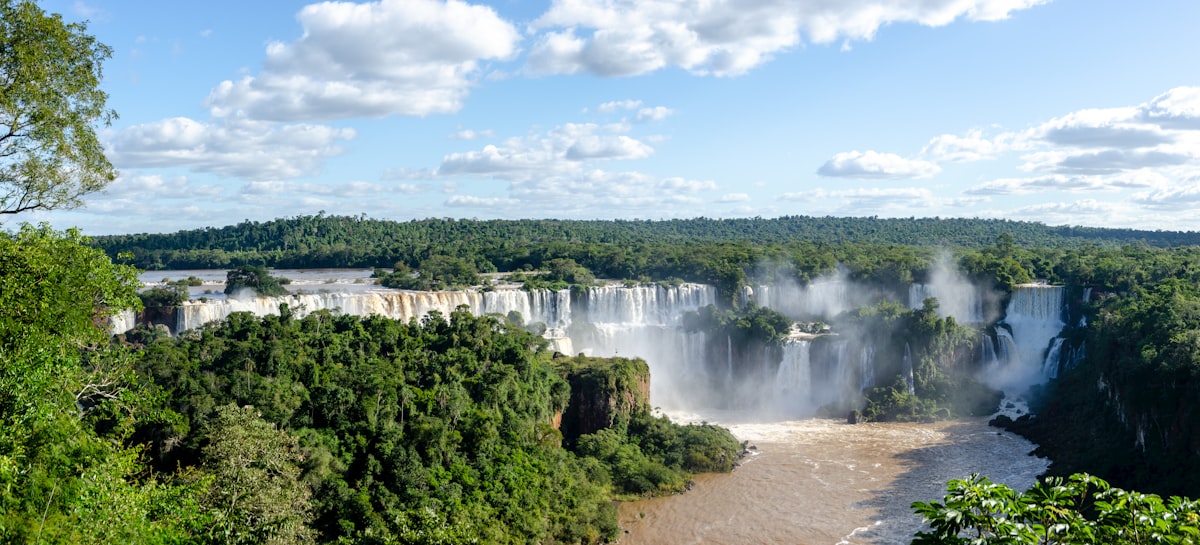
Iguazu Falls is a 2.7 km arc of 275 individual waterfalls on the border between Argentina and Brazil, surrounded by subtropical rainforest sheltering toucans, coatis, and giant otters. Eleanor Roosevelt reportedly exclaimed “poor Niagara” on seeing it for the first time. The comparison stands.
This guide covers how to get there from Buenos Aires, what to see on each side, which trails to walk and in which order, the best time to go, and what to bring. For information on tours, operators and booking, see our Iguazu Falls tours guide. If you’d like to browse and book directly, guided tours to Iguazu Falls covers boat rides, day trips from Buenos Aires, and combination packages.
Argentine Side vs Brazilian Side
The falls straddle the border, and each country operates its own national park. They offer fundamentally different perspectives — both are worth doing if time allows.
Argentine Side (Parque Nacional Iguazú)
The Argentine park puts you inside the falls. Elevated metal walkways thread between individual cataracts, and the Garganta del Diablo (Devil’s Throat) walkway extends out into the heart of the most powerful falls — at its end, you’re surrounded on three sides by water dropping 80 metres into a gorge below, soaked by mist regardless of the season.
Three trail circuits:
Garganta del Diablo (1–1.5 hours): The internal train runs from Estación Central to Estación Garganta, then a flat 1.1 km walkway leads to the platform at the falls’ edge. Go here first, at park opening, before the tour buses arrive. By 10am the platform is crowded. Allow 45 minutes on the platform.
Circuito Superior (1–1.5 hours): An elevated walkway running along the top of the falls, with views down over the lip of individual cataracts. Drier than the lower circuit and better for photography — the angle reveals the full width of individual falls and the forest canopy below.
Circuito Inferior (1.5–2 hours): Descends to river level beside the falls, with eye-level views of the cascades from below. The wettest circuit. The path ends at a dock where a free ferry runs to Isla San Martín — a small island mid-river with its own viewpoint — when water levels permit (typically April–November).
Recommended order: Garganta del Diablo first (at opening), Upper Circuit, then Lower Circuit and island. Combined circuits total approximately 8–10 km on flat or gently sloping terrain.
- Entry: approximately ARS 10,000–14,000 for non-Argentine nationals as of 2026 — check parquesnacionalesiguazu.gob.ar for current rates, which change frequently
- Opening hours: 8am–6pm daily
- Buy tickets online to skip entry queues in peak season
Brazilian Side (Parque Nacional do Iguaçu)
The Brazilian side offers the panoramic view the Argentine side cannot provide. A single 1.2 km walkway sweeps along the gorge rim with the full arc of falls visible in one frame — this is the image on every Iguazu poster, and it genuinely looks like the photograph.
The walk is shorter than the Argentine circuits but delivers a different kind of scale: from here, you see the Argentine park in the distance, the falls in their full width, and the complete geography of the system becomes clear.
- Entry: approximately BRL 90 for international visitors as of 2026 — check cataratasdoiguacu.com.br for current rates
- Opening hours: 9am–5pm daily (extended in peak season)
- The border crossing from Puerto Iguazú to Foz do Iguaçu is approximately 30 km. Check visa requirements for your nationality before crossing — rules vary and the immigration process involves both countries’ officers
Our recommendation: If you only have one day, the Argentine side. If you have two days, do the Argentine side in full on day one and Brazil in the morning of day two.
Getting There from Buenos Aires
By Air (Strongly Recommended)
Fly from Buenos Aires Jorge Newbery Aeroparque (AEP) or Ezeiza International (EZE) to Puerto Iguazú airport (IGR). Flight time is approximately 1 hour 50 minutes.
Aerolíneas Argentinas and LATAM operate the route. Fares range from approximately USD 60–80 one way booked ahead to USD 150+ for last-minute purchases. Aerolíneas runs frequent promotional fares; checking their website directly before booking via third parties is worthwhile.
By Bus (Budget Option)
Long-distance buses run overnight from Buenos Aires Retiro terminal to Puerto Iguazú. Journey time is 18–20 hours. Prices range from approximately ARS 40,000–70,000 (cama suite, fully reclining seats) as of 2026. Argentine long-distance buses are generally comfortable and punctual; departing in the evening and arriving the next morning is manageable. This is a viable budget option if time is not the constraint.
Getting from Puerto Iguazú to the Park
Puerto Iguazú town is approximately 25 km from the Argentine park entrance.
- Local bus (El Práctico): Departs from the Puerto Iguazú bus terminal every 20–30 minutes. Journey time approximately 30–40 minutes. Fare approximately ARS 1,500–2,000 one way as of 2026.
- Remis or taxi: Approximately ARS 4,000–8,000 for the transfer — faster and more convenient for groups.
Most hotels in Puerto Iguazú can arrange transfers. Uber also operates in the town.
What to Expect at the Falls
Wildlife
The park protects subtropical Atlantic Forest, one of the most biodiverse ecosystems in the Americas. What you’re likely to see:
Coatis: Raccoon relatives that move through the park in groups, comfortable around people and opportunistically food-seeking. Do not feed them — they bite, and the bites require medical attention. Keep bags zipped.
Birds: Over 400 species recorded. Toucans and large parrots are visible in the canopy on the Upper Circuit. Great dusky swifts nest inside the falls and fly through the spray continuously.
Capuchin monkeys: Present throughout the park; most likely spotted on Isla San Martín.
Butterflies: Over 500 species recorded — in the mornings they aggregate in clouds near flowering plants. Remarkable even for visitors not otherwise interested in insects.
Caimans: Visible on sunny days along river banks on the jungle walk near the lower circuits.
Water Volume and Spray
Water volume varies significantly by season. In the wet season (November to March), flow peaks and the spray radius extends far enough to soak visitors on the upper walkways. A waterproof bag cover and lightweight rain poncho are useful year-round; in peak wet season they are effectively mandatory.
In the dry season (July to September), volume drops and individual cataracts become more visible without spray obscuring the view. The Garganta del Diablo is less overwhelming but more photographable.
The Park Train
The internal train (Tren de la Selva) is free with park entry and runs between three stations: Estación Central (main entrance), Estación Garganta (Devil’s Throat), and Estación Cataratas (Upper and Lower circuits). Departures run every 15–20 minutes throughout the day. The first train to Garganta is the most important — be at Estación Central when the park opens.
Best Time to Visit
| Month | Water Volume | Crowds | Temperature |
|---|---|---|---|
| Jan–Mar | Very high | High | 28–35°C |
| Apr–May | High | Medium | 22–28°C |
| Jun–Jul | Medium | Low–Medium | 15–22°C |
| Aug–Sep | Low–Medium | Low | 18–25°C |
| Oct–Nov | Rising | Medium | 24–30°C |
| Dec | High | Very high | 28–34°C |
Best overall conditions: April–May and September–October. High water after rains, comfortable temperatures, and significantly lower crowds than summer or July school holidays.
July is Argentina’s peak domestic tourism season — accommodation and flights need booking well ahead, and the park can reach morning capacity within a few hours of opening.
Helicopter Tours Over the Falls
Helicopter tours operate from the Brazilian side (the Foz do Iguaçu airport area), as overflight of the Argentine park itself is not permitted. A 10-minute circuit covers the full falls system from above — the view clearly distinguishes the Argentine and Brazilian circuits and reveals the full U-shape of the Devil’s Throat in a way the ground-level walkways cannot. Helisul is the main operator, charging approximately USD 90–140 per person as of 2026 for the standard 10-minute flight. The extended 15-minute circuit adds the city of Foz do Iguaçu and the nearby Itaipu hydroelectric dam to the route, at approximately USD 160–200 per person.
Flights run throughout the day but the morning light (8–10am) is best for photography with the falls lit from the east. Same-week bookings are generally possible in shoulder season; book at least a week ahead in July and December–January. Your Puerto Iguazú hotel can make the booking and arrange the crossing transfer.
Day Trip Packages from Buenos Aires
For travellers with a tight Buenos Aires schedule who cannot stay overnight in Puerto Iguazú, air-inclusive day trips are available. These typically depart Aeroparque on the 6–7am flight, arrive at IGR by 9am, spend 6–7 hours at the falls with a guide, and return on the evening flight.
Operators running these packages include Tangol (Florida street, Buenos Aires) and several GetYourGuide-listed companies. Inclusive packages run approximately USD 250–400 per person covering flights, transfers, park entry, and a guide — compare current options via Iguazu Falls tours.
A genuine caveat: the day trip is logistically tight, arrives mid-morning when crowds are already building, and you miss the early-morning Garganta del Diablo before the park fills. If your schedule allows any flexibility, spending one night in Puerto Iguazú is a meaningfully better experience.
Practical Tips
- Arrive at opening: The Argentine park opens at 8am. Arriving at or before opening is the single most effective thing you can do to improve your visit. The Garganta del Diablo platform is shoulder-to-shoulder by midday in high season.
- Two-day park pass: The Argentine park sells a consecutive two-day pass at a modest discount. If you want to walk all three circuits without rushing, this is worth the investment.
- What to wear: Light, quick-drying clothes on the Lower Circuit and Garganta walkways — you will get wet. Closed shoes with grip rather than sandals; the walkways are wet and the grating can be slippery. A lightweight rain poncho packs small and pays off on the Garganta platform.
- Sun protection: Walkways offer minimal shade. SPF 50+, a hat, and sunglasses are essential from October to March.
- Food and cash: The Argentine park accepts cards for entry. Restaurants inside the park are expensive by Argentine standards — packing snacks and a refillable water bottle reduces costs. The town of Puerto Iguazú has better value restaurants.
- Electronics: A waterproof case or dry bag for your phone is strongly recommended. A GoPro or action camera handles the spray better than a DSLR on the lower circuits.
Where to Stay in Puerto Iguazú
Most visitors stay in Puerto Iguazú town (2–4 nights is typical) rather than in the park:
- Budget: Hostels and guesthouses from approximately USD 15–30 per night
- Mid-range: Comfortable hotels from approximately USD 60–120 per night — adequate for the 1–2 nights most visitors need
- Park hotels: The Meliá Iguazú inside the Argentine park has falls-view rooms and immediate park access (approximately USD 200–350 per night); the Belmond Hotel das Cataratas inside the Brazilian park is the benchmark luxury option (from USD 400+ per night)
Booking well ahead in July and December–February is essential.
Related: Iguazu Falls tours and operators · Things to do near Iguazu · Where to stay in Puerto Iguazú