December marks the start of Patagonia’s peak trekking season. The days run to 16 hours and above at this latitude, all refugios on the Torres del Paine circuits are fully operational, and every main trail is passable. Both El Chaltén and Puerto Natales are at full capacity. Anyone expecting a quiet wilderness experience in December should go in with realistic expectations — this is Patagonia at its busiest. That said, December offers the widest weather windows, the longest daylight, and the greatest trail access of any month in the season.
For a quieter alternative with fewer crowds and lower prices, see our Patagonia in November guide.
Torres del Paine in December
Torres del Paine sits in Chilean Patagonia, most conveniently reached from El Calafate via Puerto Natales (approximately 5 to 6 hours by bus, with the Cerro Castillo border crossing). In December, every refugio on the W-Trek is open and staffed. The busiest period runs from Christmas through early January, so visiting in the first two to three weeks of December gives you full trail access with slightly lower density than the holiday rush.
The W-Trek
The W-Trek takes 4 to 5 days and covers the three main viewpoints: the base of Los Torres on the eastern arm, Valle del Francés in the centre, and Lago Grey on the west. It can be walked in either direction; most self-guided trekkers start from Las Torres (accessible by bus from Puerto Natales) and finish at Paine Grande, or reverse that route.
The two main refugio operators are Fantastico Sur — which runs Las Torres Base and Chileno refugios on the eastern arm — and Vertice Patagonia, which operates Paine Grande, Refugio Grey, and Dickson further around the circuit. Mountain Lodges of Patagonia runs a fully guided, lodge-to-lodge version with higher-end accommodation and guided services. For self-guided trekkers doing the W, a combination of Fantastico Sur and Vertice bookings covers the full route.
Booking timeline: For December, book refugio beds 9 to 12 months in advance. Reservation windows with Fantastico Sur and Vertice typically open in March or April for the following December season. CONAF camping permits — required for all designated campsites within the park, including Torres, Chileno, Italiano, Paine Grande, and Grey — also sell out rapidly for December. If you are reading this in September or later, check availability immediately; options may be limited to Mountain Lodges of Patagonia or agency packages that hold reserved spots. Day hikes into the park from Puerto Natales are possible if the W-Trek is fully booked — the Mirador Base Las Torres return trip requires no overnight booking.
Day Hikes in December
Beyond the full W, day hikes from the Pudeto catamaran landing and from Las Torres main entrance are an option for those without refugio reservations. The trails to Mirador Cuernos and around Lago Pehoe are accessible without overnight permits. Weather in December can shift rapidly — carry full waterproofs even for day outings.
Fitz Roy and Cerro Torre in December
El Chaltén, 230km north of El Calafate along a paved road, is the Argentine trekking hub for Los Glaciares National Park. Entry is free, with no advance permits required for day hikes. Register at the ranger station at the village entrance before heading out — rangers give a weather briefing and note trail closures.
Laguna de los Tres
The route to Laguna de los Tres (21km round trip, 8 to 9 hours, 1,200m elevation gain) is the signature hike of Argentine Patagonia. The final 400m of ascent climbs a steep loose-rock section to the lookout directly beneath the Fitz Roy massif. December gives the best statistical probability of clear summit views — Fitz Roy is cloud-free roughly one day in three across the season. With three or four nights in El Chaltén, most trekkers catch at least one usable window.
In December, the Laguna de los Tres trail is busy. Expect company on the climb, particularly in the pre-dawn hours when headlamp-equipped trekkers head up to catch sunrise. Starting at first light (5am in December) rather than pre-dawn avoids the coldest temperatures while still getting you to the lagoon early.
Camping at Poincenot: The free designated campsite at Poincenot, on the Laguna de los Tres approach, allows an early start from the mountain. It fills up in December — book the campsite online through the Los Glaciares park system in advance.
Laguna Torre and Cerro Torre
The Laguna Torre trail (20km, 6 to 7 hours) reaches the glacial lagoon at the base of Cerro Torre. The tower is more frequently cloud-wrapped than Fitz Roy, but the trail through the lenga beech forest and across the lateral moraine is a full day’s walk with or without summit visibility. The lagoon itself, rimmed with ice chunks calved from the glacier, is the payoff.
For full route details and elevation profiles, see our Fitz Roy trek guide.
Perito Moreno Glacier in December
Perito Moreno is 80km from El Calafate along a sealed road. Entry to Los Glaciares National Park costs approximately USD 25 to 30 for foreign nationals (2025-2026 rates). The free walkway system descends through multiple levels of viewing platforms directly facing the glacier’s 5km-wide ice face. No additional booking is required for the walkways.
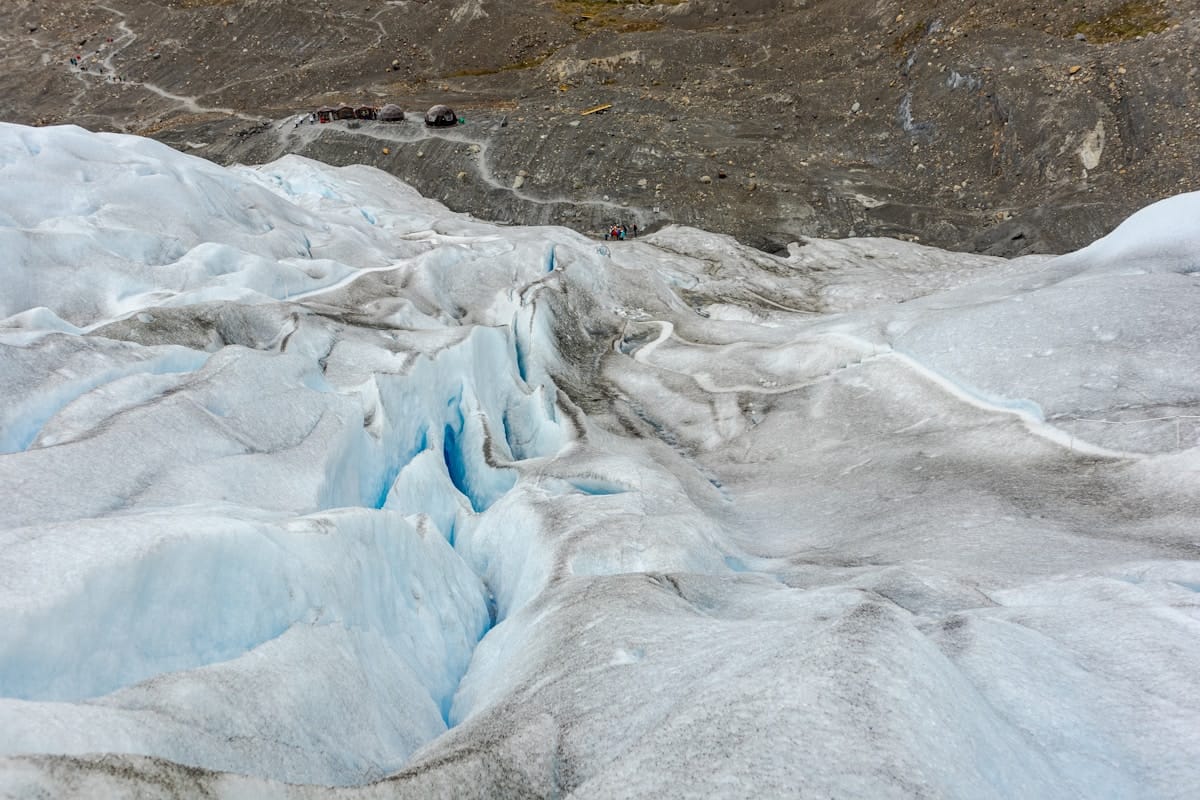
Mini-Trekking: Around 90 minutes on the glacier surface with crampons provided. A short boat crossing takes you to a landing point near the glacier, from which the trek begins. Cost runs approximately USD 80 to 100. Book through operators in El Calafate — departures fill quickly in December. The activity is suitable for most fitness levels.
Big Ice: A more demanding option covering approximately 5 hours on the ice and reaching higher elevation on the glacier surface. Cost is approximately USD 150 to 170. Groups are smaller and fitness requirements are higher. Only one or two departures run per day; book at least a week ahead in December.
December brings a high frequency of calving events — large ice chunks breaking from the glacier face with a crack that can be heard from the walkways. The glacier advances at roughly 2m per day on average, making calving a regular occurrence throughout the month.
December Weather in Patagonia
Temperatures at El Calafate and El Chaltén in December typically range from 5°C to 18°C during the day, with mornings often starting at 5°C to 8°C before warming through the morning. At altitude — above 1,000m, particularly on the final approach to Laguna de los Tres — temperatures can drop to near zero even in December when wind is strong.
Wind is the primary variable. Sustained gusts of 80 to 120 km/h are not unusual and can shut down exposed trail sections, particularly the upper Laguna de los Tres climb. Afternoon wind is stronger than morning wind — the most reliable trekking window is before 10am. Rain arrives in fast-moving fronts; a dry morning can become a wet afternoon with little warning. Expect around 40 to 60mm of rainfall across the month in the El Calafate area.
Daylight extends to more than 16 hours in December: first light arrives before 5am and last light holds past 10pm. This is a genuine advantage that sets December apart from November and October. You can wait out morning wind with a late breakfast and still have hours of walking time ahead, or rest in the midday heat and continue into the long evening.
UV intensity is high at southern latitudes and increases further when reflected off snow patches or glacier ice. SPF 50 or higher is the working minimum.
What to Pack for December
Layering system:
- Base layer: merino wool or synthetic moisture-wicking fabric; avoid cotton entirely
- Mid layer: mid-weight fleece or synthetic insulated jacket (a light down layer is useful for summit areas)
- Shell: hardshell jacket with taped seams rated for sustained rain and wind; softshells do not provide adequate protection in Patagonian conditions
- Wind trousers or over-trousers for exposed sections above treeline
Sun and eye protection: UV400-rated sunglasses are essential year-round. For Perito Moreno Mini-Trekking or Big Ice, bring side-shield glasses or glacier goggles to reduce reflected glare off the ice surface. Wide-brim hat or buff for face coverage on open ridges.
Footwear: Waterproof hiking boots with ankle support for multi-day routes and any trail where snow or mud is likely. Trail runners are workable on the main El Chaltén day hikes in dry conditions but provide less security on the steep final section of the Laguna de los Tres climb.
Other essentials: Trekking poles (most useful on the steep descent from Laguna de los Tres), minimum 3-litre water carrying capacity (water from glacial streams is safe after filtering or treating), portable battery pack (no charging points on trail), and a buff or balaclava for cold mornings.
El Calafate vs El Chaltén in December
El Calafate has the main airport (FTE), the largest accommodation selection, restaurants open year-round, and direct access to Perito Moreno. It is the better base if combining a glacier visit with other Patagonia activities, or if you want a broader range of accommodation options. Most cross-border trips to Torres del Paine are also organised from El Calafate.
El Chaltén is a dedicated trekking village with limited services beyond hostels, a handful of restaurants, and gear shops. If Fitz Roy and Cerro Torre are the primary goals, base yourself in El Chaltén for at least two to three nights to give yourself a weather window. There is no airport — access is by bus only.
TAQSA and Chalten Travel buses run daily between El Calafate and El Chaltén during December. The journey takes approximately 3 hours and costs around USD 25 to 30 each way. Buses from El Calafate typically depart in the morning; return buses from El Chaltén in the afternoon. Book at least 48 hours ahead in December.
For those wanting flexibility between Perito Moreno, El Chaltén, and Torres del Paine, see our guide to renting a car in Patagonia.
December Booking Checklist
- W-Trek refugios (Fantastico Sur, Vertice): book 9 to 12 months ahead, reservation window opens March-April
- CONAF camping permits: book as soon as available; December fills completely
- Perito Moreno Big Ice: book at least 7 days ahead, one or two departures daily
- El Chaltén campsites (Poincenot): book online via the Los Glaciares park system
- El Calafate to El Chaltén bus: book 48 hours ahead minimum in peak season
For full context on Argentina in high season, see our Argentina in December guide and our best time to visit Argentina overview.