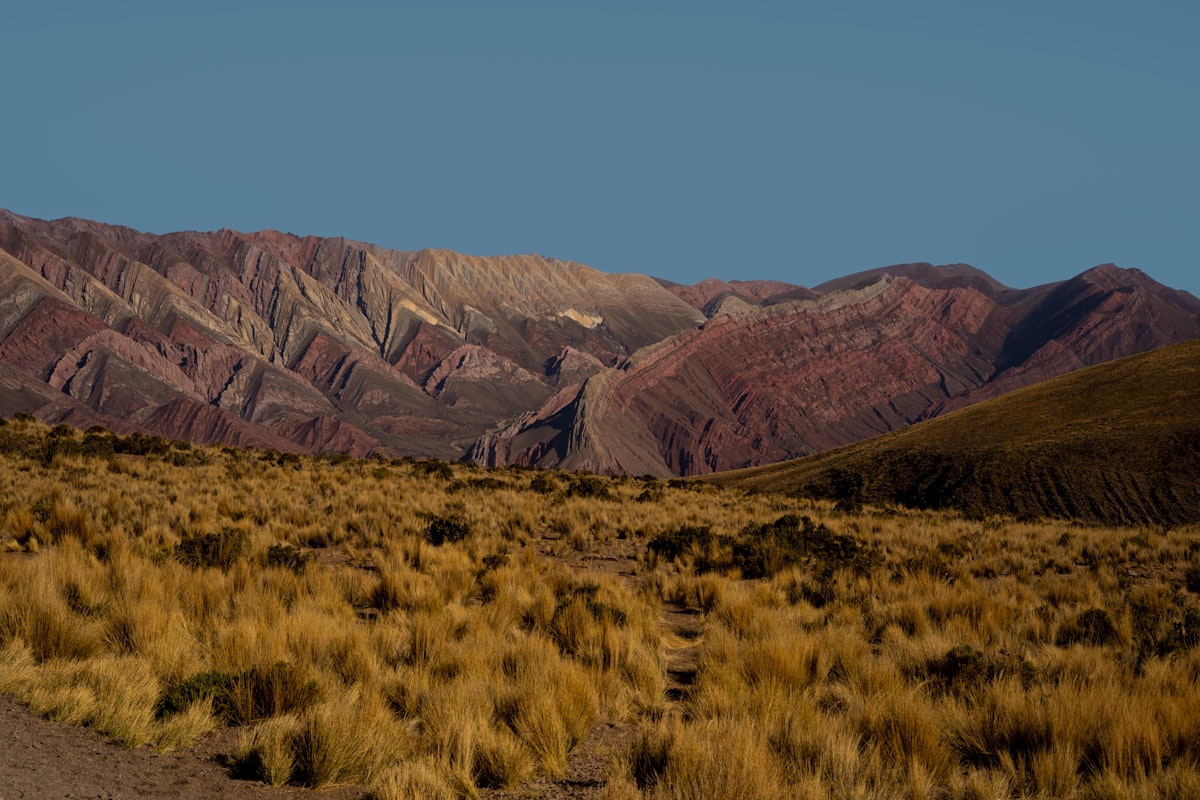
The northwest of Argentina - Salta and Jujuy provinces - offers landscape and culture unlike anywhere else in the country. The Andes here are not just peaks but coloured canyons, salt flats, and high-altitude wetlands (punas) that feel more like Bolivia than Patagonia. The region’s colonial architecture, indigenous Andean traditions, and world-class wine route make it one of the most rewarding parts of Argentina to visit.
Salta city is the hub. Most visitors base themselves here and take day or multi-day tours into the surrounding provinces. These are the four essential routes.
Quebrada de Humahuaca
Argentina’s most significant UNESCO World Heritage landscape runs for 155 km along the Río Grande valley between Volcán village in the south and Iturbe in the north. The canyon walls change colour through the day as the light shifts - reds and purples in the morning, oranges and yellows at noon.
The main stops:
Purmamarca (2,192m) is the most visited village in the Quebrada, built around a colonial church and backed by the Cerro de los Siete Colores (Hill of Seven Colours). The colours - red, pink, white, ochre, violet, green, yellow - are layered sedimentary rock strata, most vivid in the late afternoon. The village market sells woven textiles, alpaca goods, and ceramite pottery; quality is variable but the craftsmanship from local artisans is genuine.
Tilcara (2,461m) has a wider selection of restaurants, accommodation, and the Pucará de Tilcara - a pre-Columbian Omaguaca fortress on a hill above town. Entry costs approximately ARS 2,500 as of 2026. The town’s Museo Arqueológico has a significant collection of local pre-Hispanic artefacts (entry approximately ARS 1,500).
Humahuaca (2,939m) is the largest town in the valley. The Cabildo’s mechanical statue of San Francisco Solano emerges each day at noon to bless the town - a slightly eccentric tradition worth witnessing. The surrounding area, especially the Serranía de Hornocal with its 14 colours of exposed strata, is accessible on a half-day excursion from Humahuaca.
Transport options:
- By bus: Andesmar and Balut operate regular services from Salta terminal to Jujuy, Purmamarca, Tilcara, and Humahuaca. Salta to Tilcara takes approximately 3 hours (ARS 4,000–6,000 as of 2026). Travelling independently gives flexibility to stop where you want.
- Guided day tour from Salta: Full-day tours including transport and a guide typically cost ARS 50,000–90,000 per person as of 2026. GYG operators run this route and include Purmamarca and Tilcara with commentary.
- Hired driver: Remise drivers in Salta offer all-day hire for approximately ARS 80,000–120,000 for the vehicle (typically 1–4 people), which works out cheaper than individual tour prices for groups.
Salinas Grandes
At 3,400m above sea level, the Salinas Grandes is a 212 sq km salt flat shared between Jujuy and Salta provinces. It’s smaller than Bolivia’s Salar de Uyuni but requires no international border crossing and is accessible on a day tour from Salta or Jujuy.
The approach is half the experience. From Purmamarca, the road climbs the Cuesta de Lipán - a series of hairpin bends rising from 2,192m to the altiplano at 4,000m, with views back down the valley that are genuinely spectacular. The salt flat itself is blinding white under sun, with shallow brine pools reflecting the sky at certain times of year (June–September is reliable for water coverage; the dry season can leave sections simply white crust).
Accessing Salinas Grandes:
- No public bus runs directly to the salt flat. Visitors need a guided tour, hired car, or remise.
- A combined Quebrada de Humahuaca + Salinas Grandes day tour from Salta costs approximately ARS 80,000–140,000 per person including transport and guide.
- From Purmamarca (if you’re already in the Quebrada), the Salinas are 64 km away on RN52. A remise from Purmamarca costs approximately ARS 30,000–50,000 for the round trip.
Altitude note: Salinas Grandes sits at 3,400m - acclimatize in Salta (1,187m) for at least one night before visiting. Carry water, sunscreen, and sunglasses (the reflected light off the salt is intense).
Cachi
Cachi is a small colonial town in the Calchaquí Valleys, 157 km from Salta by road. The approach via RN33 is one of the most dramatic drives in Argentina - the Cuesta del Obispo, a mountain pass reaching 3,347m, descends through the Cardones National Park, a protected forest of giant cactus (cardón, Echinopsis terscheckii) at densities that feel prehistoric.
The town itself is quietly spectacular: a whitewashed 18th-century colonial church faces a verdant plaza, backed by snow-capped Andean peaks. Population is approximately 7,000. There are no chain hotels or fast food outlets.
What to see in Cachi:
- Iglesia San José - whitewashed adobe colonial church (1796) with a cactus-wood ceiling; free entry
- Museo Arqueológico Pío Pablo Díaz - pre-Columbian artefacts from the Calchaquí Valley, entry approximately ARS 2,000
- The drive along the Calchaquí Valley north and south of Cachi, where small villages are separated by long stretches of Andean scenery
Getting there:
- No direct public transport from Salta to Cachi (the mountain road is too narrow for large buses at some points). Guided day tours or hired car are the practical options.
- Guided full-day tours from Salta: approximately ARS 70,000–110,000 per person including transport, guide, and lunch stop.
- Hiring a remise from Salta for the day (Cachi + Cuesta del Obispo): approximately ARS 100,000–150,000 for the vehicle.
Allow at least 3.5–4 hours driving each way, including the mountain pass.
Cafayate Wine Route
Cafayate (1,683m elevation) sits 190 km south of Salta along RN68, which cuts through the Quebrada de las Conchas - a canyon of red sandstone formations with names like El Anfiteatro, Los Castillos, and La Garganta del Diablo (the Devil’s Throat). The canyon road is one of Argentina’s most photogenic drives.
The Cafayate wine region produces primarily Torrontés (Argentina’s signature white grape, highly aromatic and dry) alongside Malbec and Tannat at altitude. The combination of 300+ days of sunshine, cold nights, and dry air produces wines with intense aromatics and good acidity.
Named bodegas to visit:
- Bodega El Esteco - the region’s most established producer; winery tours and tasting from approximately ARS 5,000–8,000 per person; large-scale operation with good English-language tours
- Bodega Nanni - family-run organic producer in the town itself; intimate tastings approximately ARS 3,500
- Finca Las Nubes - hillside winery with views over the valley; tours approximately ARS 6,000
- Bodega Domingo Hermanos - one of the oldest producers in Cafayate; traditional methods, small visitor numbers
Getting there from Salta:
- Bus: Ale Hermanos and Aconquija run daily services from Salta terminal to Cafayate (approximately 3.5 hours, ARS 6,000–8,000 each way as of 2026). The bus runs through the Quebrada de las Conchas but doesn’t stop at viewpoints - for the scenery, a car or tour is better.
- Guided wine tour: Full-day tours from Salta including transport, winery visits with tastings, and lunch cost approximately ARS 90,000–150,000 per person. GYG operators offer Cafayate wine routes that include three or four bodega visits.
- Hired car or remise: Allows freedom to stop in the quebrada and choose your bodegas. Remise hire from Salta to Cafayate and back costs approximately ARS 120,000–180,000 for the vehicle.
Staying overnight: Cafayate has good mid-range options including Patios de Cafayate (a winery hotel, from approximately $150–250 USD/night as of 2026) and several well-run guesthouses at ARS 30,000–60,000/night. Staying overnight means you can visit bodegas the following morning without the time pressure of a day tour.
Top Salta & Jujuy Tours: Prices at a Glance
Most tours depart from Salta city with hotel pickup. All GYG-listed options below offer free cancellation up to 24 hours before departure. Prices are approximate as of 2026.
| Tour | Duration | Includes | Price (approx.) |
|---|---|---|---|
| Quebrada de Humahuaca Full-Day Tour | 12–14 hrs | Transport, English guide, Purmamarca + Tilcara + Humahuaca | from $35 pp |
| Humahuaca & Hornocal: Andean Viewpoints | 14 hrs | Transport, guide, Cerro de los Siete Colores, Hornocal viewpoint | from $45 pp |
| Salinas Grandes + Purmamarca Day Trip | 8–10 hrs | Transport, guide, salt flat + Hill of Seven Colours | from $40 pp |
| Cafayate Wine Route Day Tour | 10–12 hrs | Transport, 3–4 bodega visits + tastings, Quebrada de las Conchas | from $50 pp |
| Cachi + Cuesta del Obispo Full Day | 10 hrs | Transport, guide, mountain pass + colonial town | from $40 pp |
Browse all options via Salta and Jujuy tours on GetYourGuide.
Booking Salta Tours
Most multi-destination tours - combining the Quebrada, Salinas Grandes, and sometimes Cachi or Cafayate - can be booked through operators at the Salta bus terminal or through your accommodation. GetYourGuide’s Salta selection includes English-language options and multi-day combinations across the region.
For independent travellers planning their own route, renting a car in Salta gives the most flexibility, particularly for the Quebrada and Cafayate drives where stopping at viewpoints makes a significant difference.
See also: Salta city guide · Getting around Argentina · Best time to visit Argentina