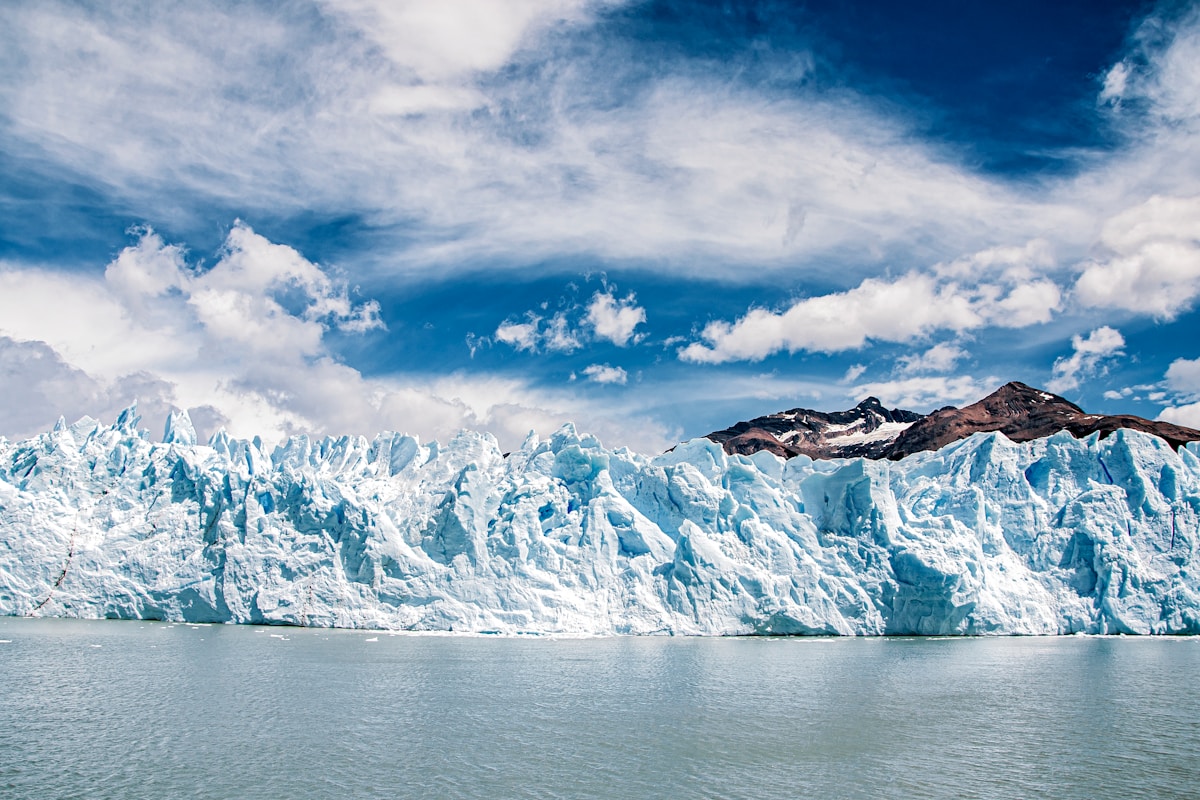
Perito Moreno Glacier is the most visited natural attraction in Argentine Patagonia - and it earns the reputation. Named after Francisco Moreno, the nineteenth-century Argentine explorer who surveyed much of Patagonia, the glacier forms part of the Southern Patagonian Ice Field and flows from the Campo de Hielo Sur into the Lago Rico arm of Lago Argentino. The 5-kilometre-wide, 60-metre-high ice face advancing into the lake is one of those rare geographical phenomena that is more impressive in person than in photographs, primarily because photographs cannot convey the sound: the constant cracking and groaning of the ice, followed by the thunderous collapse of a calving event and the waves it sends across the lake.
The glacier is located in Los Glaciares National Park, 80 kilometres west of El Calafate. All visits start in El Calafate - the infrastructure, tours, and accommodation for the glacier are based there. The glacier itself has no on-site services beyond the boardwalk and a basic café.
The Boardwalk
The primary access point is the Península de Magallanes, which juts into Lago Rico directly opposite the glacier face. A network of walkways and stairways runs along the peninsula’s ridge and descends to several viewing platforms at water level. The total walkable distance is approximately 4 kilometres, with multiple viewpoints at different angles and distances.
The ice face is a continuously moving, cracking, and collapsing structure. Calving events - portions of the ice face breaking off and falling into the lake - occur several times per hour during the warmest part of the day. The sound carries across the water several seconds before the visual impact as the fallen ice creates waves that roll toward the boardwalks. Large calving events send 20–30 metre columns of ice into the lake. Spend two to three hours at the boardwalk and you will see multiple events.
The colour of the ice varies with depth and compression. Deeply compressed glacier ice appears blue rather than white because the dense structure absorbs red and yellow wavelengths while reflecting blue. Surface ice and recently calved blocks are white or pale blue; older, deeper ice exposed at the face ranges from aquamarine to deep cobalt.
Tour Options from El Calafate
Standard day tour (boardwalk): The most common format. A minibus departs El Calafate in the morning (8am or 9am, depending on operator), drives 80 kilometres to the glacier, and returns in the afternoon (2pm, 3pm, or 5pm). Total time at the glacier: 3–4 hours. Operators are clustered on El Calafate’s pedestrian main street; prices are similar across all of them. The tour includes the national park entry fee or this is sometimes collected separately at the park gate.
Big Ice (Minitrekking or Trekking): Extends the standard day tour with an ice trek component. After arriving by minibus, participants take a short boat ride to the glacier edge, hike 15–20 minutes through forest, and don crampons at the glacier margin. Groups of approximately 16 walk the glacier’s upper surface for 1.5–2 hours with a guide, ending at a rest stop where guides serve whisky poured over glacier ice - an optional tradition that most participants embrace. The full day from El Calafate runs approximately 10–11 hours. Pre-booking is required; capacity is limited and sells out in January–February. The terrain on the ice is uneven and requires a reasonable level of fitness and mobility.
Minitrekking is a shorter ice walk variant (approximately 1.5 hours on the ice) using the same boat access. Less demanding and suitable for those who want ice contact without the full Big Ice commitment.
Nautilus boat tour (Navegación): A boat excursion on Lago Argentino that approaches the glacier face from the water rather than the boardwalk. Launches depart from a dock near the boardwalk area. The boat passes within 200–300 metres of the ice face - closer than the boardwalk viewpoints - and provides a different perspective on the glacier’s scale. Duration approximately 1.5 hours. Can be combined with the boardwalk visit on the same day.
Upsala and Spegazzini glaciers: A full-day boat excursion from Puerto Bandera, 50 kilometres from El Calafate, visiting two other glaciers within Los Glaciares National Park that are not accessible by road. The Upsala glacier is larger than Perito Moreno but is in retreat and is now approached by boat to a safe viewing distance. This excursion provides broader context for the ice field beyond the Perito Moreno spectacle. Departs early morning, returns late afternoon; book through El Calafate operators.
Self-Drive Option
A rental car from El Calafate reaches the glacier in approximately 1 hour and 15 minutes on a fully paved road. The route is straightforward and well-signed. Driving yourself allows flexibility - arriving at the 8am opening before tour buses, staying longer than standard tour times, and departing on your own schedule. The entry fee is collected at the park gate regardless of how you arrive.
Rental car companies (including international chains) operate from El Calafate airport. An international driving licence is required.
Entry Fees and Logistics
The park collects an entry fee at the barrier approximately 15 kilometres from the glacier. Fee categories differ for Argentine nationals, Mercosur residents, and international visitors. Current fee amounts are posted at the barrier; they have increased annually in recent years and are best confirmed immediately before visiting.
Tour operators in El Calafate run minibus services to the glacier with several departure times in the morning (typically 8am and 9am) and return trips in the afternoon (around 2pm, 3pm, and 5pm). The standard excursion allows 3–4 hours at the glacier. Prices are fixed and similar across operators; booking the day before is sufficient except during peak season (January–February), when some services fill.
Top Perito Moreno Glacier Tours: Prices at a Glance
Park entry (~ARS 45,000 as of 2026) is not included in most tour prices and is paid separately at the gate. All GYG-listed tours depart from El Calafate and offer free cancellation up to 24 hours before departure.
| Tour | Duration | Includes | Price (approx.) |
|---|---|---|---|
| Guided National Park + Glacier Tour | Full day | Minibus from El Calafate, guide, 3–4 hrs at boardwalk | from $60 pp |
| Glacier + Optional Boat Navigation | Full day | Boardwalk + 1.5-hr Nautilus boat to ice face | from $75 pp |
| Minitrekking on the Glacier | Full day | Boat transfer, crampons, 1.5 hrs on ice, whisky on ice | from $371 pp |
| Big Ice Trek | Full day | Boat transfer, crampons, 3-hr glacier walk (ages 18–50) | from $459 pp |
| Upsala + Spegazzini Glaciers Boat Tour | Full day | All-day boat from Puerto Bandera, 2 remote glaciers | from $80 pp |
Book El Calafate glacier tours through GetYourGuide or Klook — Klook’s Big Ice listing includes instant confirmation and is a reliable option for January peak season when local capacity sells out.
Practical Details
Opening hours: The park opens at 8am. Arriving at or just after opening is the best strategy for avoiding the peak crowd from group tours, which arrives between 10am and 12pm.
What to wear: The boardwalk is exposed to wind off the lake and spray from the falls. A windproof jacket and waterproof trousers are sensible regardless of the morning weather. Sun protection is necessary on clear days - the combination of latitude and reflected light from the ice is intense. Sunglasses are essential.
What to bring: Water and food from El Calafate are more practical than relying on the on-site café, which is consistently crowded during peak hours. Binoculars are useful for watching detail on the ice face from the lower platforms.
Photography: The boardwalk’s lower platforms, close to the waterline, provide the most dramatic compositions. Early morning has the cleanest light. Overcast conditions produce the most saturated blue in the ice; direct sun creates more contrast. A polarising filter is useful in direct sun to manage highlights on white ice surfaces.
Calving events: Portions of the ice face calve into the lake throughout the day. The frequency increases during the warmer midday hours. Calving events produce a sound that carries across the lake 10–15 seconds before the ice hits the water. Sustained watching is rewarded - large events produce waves visible from the boardwalk.
Combining with El Chaltén
Most visitors to southern Patagonia combine El Calafate (Perito Moreno) with El Chaltén (Fitz Roy trekking). The bus between the two runs daily in the trekking season and takes approximately 3.5 hours. The standard itinerary is 2 nights in El Calafate (one full day at the glacier) and 3–4 nights in El Chaltén (Laguna de los Tres and Laguna Torre hikes). This combination gives a strong cross-section of what Argentine Patagonia offers without requiring very long distances. The two experiences are complementary: one is direct access to an extraordinary glacier system, the other is active mountain trekking in the Fitz Roy massif.
Perito Moreno and El Calafate tours include glacier walks, boat excursions, and full-day guided visits to Los Glaciares National Park. For Big Ice and Minitrekking experiences with advance booking and instant confirmation, Klook is worth checking alongside local operators - particularly useful for January peak season when capacity sells out fast. If your plans shift after arriving in El Calafate, check last-minute Argentina tours for same-day glacier excursion availability.
Related: El Calafate city guide · El Calafate things to do · Los Glaciares National Park guide · El Chaltén trekking hub · Fitz Roy trek guide · Argentina Patagonia itinerary